
Musty Odor but No Visible Mold? What a Professional Inspection Should Investigate
A persistent odor deserves investigation—not an immediate conclusion
A musty or damp odor can be one of the first clues that a building has experienced excess moisture. It may be most noticeable near a basement stairway, when the HVAC system starts, after rainfall, during humid weather, or when a closed room is opened.
The odor matters, but it does not answer the entire question. It cannot establish where the source is located, how large the affected area may be, whether mold is present, or what corrective work is appropriate. Other building materials, drains, stored contents, mechanical systems, and moisture-related conditions can also produce odors.
That is why a professional inspection should follow the evidence. The goal is to understand the building and moisture conditions before recommending testing, remediation, encapsulation, mechanical changes, or reconstruction.
Step 1: Build the water and odor history
The inspection begins before an instrument touches a wall. A useful history can narrow a large building into a practical set of investigation priorities.
The inspector may ask:
- When was the odor first noticed?
- Is it constant or intermittent?
- Is it stronger after rain, during humid weather, or when heating or cooling operates?
- Has the property experienced roof, plumbing, appliance, foundation, drainage, or HVAC-condensate problems?
- Which repairs were completed, and were affected materials dried or removed?
- Are there finished walls or flooring over a previously damp basement or slab?
- Does the odor appear in one room, near a return grille, or throughout the building?
- Have contents been moved, stored, or brought in from another water-damaged location?
Patterns matter. An odor that increases after rain may suggest a different investigation path than one associated with air-handler operation or cooling-season humidity. The pattern is not a diagnosis, but it helps the inspector prioritize the survey.
Step 2: Perform a systematic visual inspection
EPA notes that mold is often found through visual inspection, including in places that are wet, damp, or smell musty. A professional survey should examine more than the room where the odor is strongest.
Relevant observations may include:
- Staining, swelling, deterioration, or delamination
- Peeling paint or damaged finishes
- Efflorescence or other indications of foundation moisture
- Condensation on surfaces, pipes, ducts, or equipment
- Plumbing supply, drain, or appliance connections
- Roof penetrations, flashing, attic sheathing, and insulation conditions
- HVAC condensate pans, drains, cabinets, coils, insulation, and nearby materials
- Crawl-space soil, vapor-retarder, drainage, humidity, and framing conditions
- Basement walls, rim joists, finished assemblies, carpet, and padding
- Exterior grading, gutters, downspouts, penetrations, and drainage pathways
An inspector should distinguish an observation from a conclusion. A stain may document a previous event without proving that a material is currently wet. A clean-looking surface may conceal a condition within an assembly. Each finding needs context.
Step 3: Map moisture using appropriate tools
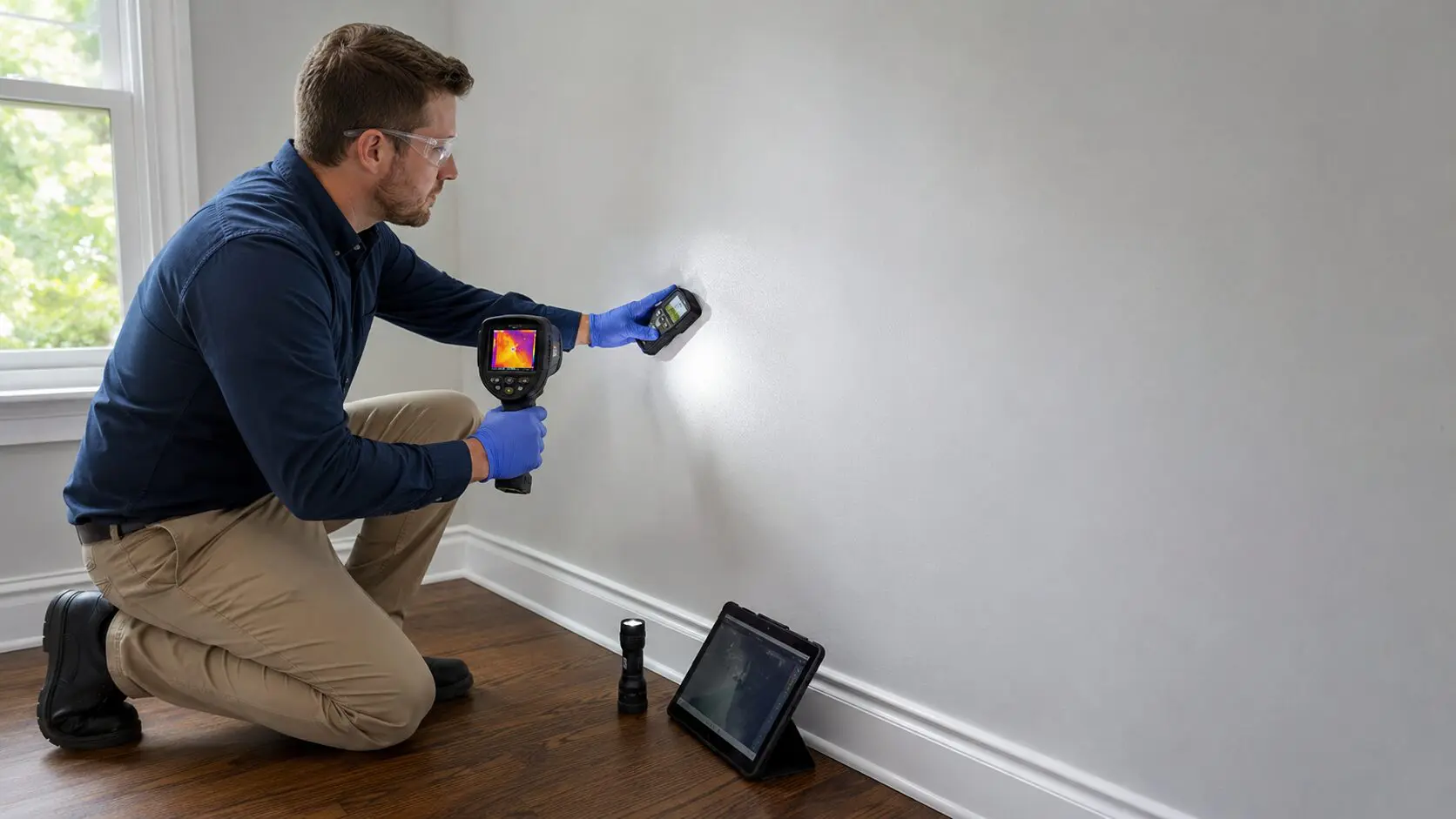
Moisture meters, hygrometers, thermal-imaging devices, and other tools can improve a building investigation when their limitations are understood.
Moisture meters
Moisture meters can help compare suspect materials with suitable reference areas. Readings must be interpreted based on the material, instrument mode, depth, calibration, surface conditions, temperature, and possible conductive interference.
A reading may identify an area that deserves further examination. It does not identify mold, determine species, or diagnose an occupant’s health condition.
Thermal imaging
A thermal camera displays surface-temperature patterns. Those patterns may be influenced by moisture, insulation, air leakage, thermal bridging, sunlight, mechanical operation, or other factors.
A suspicious thermal pattern should be corroborated with an appropriate moisture-measurement method or another observation. A thermal image by itself cannot confirm or rule out mold.
Relative humidity and dew point
Indoor and outdoor temperature and relative-humidity measurements can help explain condensation potential and mechanical-system performance. One reading is a snapshot, so longer-term monitoring may be useful when a condition is intermittent.
The purpose of the tools is not to make the inspection look technical. It is to answer building questions more reliably.
Step 4: Examine likely concealed or connected areas
EPA identifies several places where hidden mold or water damage may occur, including behind drywall, wallpaper and paneling; beneath carpets; in crawl spaces; around pipe chases; within certain ventilation components; and beneath roof materials.
The inspection method should be proportional to the evidence. Options may include:
- Accessing an existing attic, crawl-space, mechanical, or plumbing opening
- Looking behind removable access panels
- Inspecting carpet edges or padding where appropriate
- Using a borescope through an authorized, controlled opening
- Comparing adjoining rooms or levels along a plumbing or drainage pathway
- Evaluating the HVAC system when odor distribution appears related to operation
Hidden-condition investigations require caution. Disturbing a contaminated assembly can release dust and particles. The inspector should explain access limitations, obtain authorization before destructive investigation, and use appropriate controls and personal protective equipment where conditions require them.
Step 5: Decide whether sampling will answer a defined question
Sampling is a tool—not a substitute for a building investigation.
EPA says sampling is generally unnecessary when visible mold growth is present and confirms that no federal mold-spore compliance limits exist. CDC/NIOSH does not recommend routine air sampling for building evaluations and notes that short-term results may not represent actual exposure.
Sampling may still be useful in selected circumstances, such as:
- Investigating a defined concealed-condition question
- Differentiating a questionable surface condition
- Establishing project-specific information requested by an environmental professional
- Supporting a post-remediation verification plan when analytical criteria were defined
The sampling plan should state what question the sample is intended to answer, where it will be collected, why that location was selected, what limitations apply, and how the result will affect the decision.
A laboratory result should be interpreted with the inspection findings. It should not be presented as a medical diagnosis, proof that a building complies with a nonexistent federal airborne-mold standard, or a guarantee that an occupant will or will not experience symptoms.
Step 6: Document findings, limitations, and next actions
A useful report should help the client understand what was observed and what remains uncertain. Depending on the scope, it may include:
- Inspection and moisture-event history
- Areas inspected and areas not accessible
- Photographs and location references
- Moisture, temperature, and humidity observations
- Instrument types and relevant limitations
- Visible material conditions
- Potential moisture pathways requiring correction
- Sampling methods and results, if sampling was performed
- Recommendations for additional investigation, source correction, remediation, drying, or monitoring
- Conditions that should be evaluated by a roofer, plumber, HVAC contractor, foundation specialist, healthcare professional, or another qualified party
The report should separate facts, interpretations, and recommendations. It should not overstate what the inspection or instruments can establish.
Nashville and Middle Tennessee inspection priorities
During the cooling season, Nashville-area inspections frequently need to consider HVAC condensate, cold-surface condensation, duct or cabinet insulation, and humidity control. Crawl spaces, attic and roof conditions, plumbing events, exterior drainage, and storm-related water entry may also contribute.
A musty odor near an HVAC return may justify inspecting the system and connected building areas, but it does not prove that the HVAC system is contaminated. Likewise, an odor near a crawl-space entry does not establish that encapsulation is automatically the correct solution. The moisture source and building configuration should be evaluated first.
Vanguard Environmental provides building-focused mold and moisture inspections throughout Nashville and Middle Tennessee. Call 615.359.6860 or visit www.vanguardenvironmentalintl.com to request an inspection.
How to prepare for the inspection
Homeowners can make the investigation more useful by gathering:
- Dates and photographs from leaks or water events
- Roofing, plumbing, HVAC, waterproofing, or restoration invoices
- Prior inspection or laboratory reports
- Notes about when and where the odor is strongest
- Information about recent painting, flooring, furniture, cleaning products, or stored contents
- Access instructions for attics, crawl spaces, basements, mechanical rooms, and utility areas
Avoid masking the odor with fragrances immediately before the appointment. Do not open walls or disturb suspected concealed growth without an appropriate plan.
Frequently asked questions
Does a musty odor prove that mold is present?
No. It is an important clue that can help direct an investigation, but the source and affected area must be evaluated. Other materials and building conditions can also create odors.
Can a moisture meter find mold?
No. A moisture meter measures or estimates moisture-related properties in materials. It can identify areas for further investigation but does not identify mold.
Can a thermal camera see mold?
No. It displays surface-temperature patterns. Suspect patterns should be verified using appropriate moisture measurements or other observations.
Is mold sampling always required?
No. Sampling should answer a defined question. EPA and CDC/NIOSH do not recommend treating routine air sampling as a substitute for visual and moisture investigation.
Will the inspector open walls?
Not automatically. Controlled openings may be considered when evidence supports them, the client authorizes them, and appropriate precautions can be used. Access and restoration responsibilities should be agreed upon first.
Is a mold inspection a medical evaluation?
No. Environmental professionals evaluate buildings and environmental conditions. Healthcare professionals diagnose and treat patients.